Wood Carving With an Angle Grinder: Discs, Technique and Safety
Published
As an Amazon Associate we earn from qualifying purchases. This does not change our picks. Affiliate disclosure
New to Prime? Try Prime free for fast, free shipping on eligible items.
Gear for this job
All 7 picks comparedProxxon 38644 Die-Cast Aluminum Power Carver MOS
See price on AmazonSee it on AmazonARBORTECH Power Chisel Kit PCH.FG.900.20
See price on AmazonSee it on AmazonArbortech Precision Carving System, 3 Piece
See price on AmazonSee it on Amazon
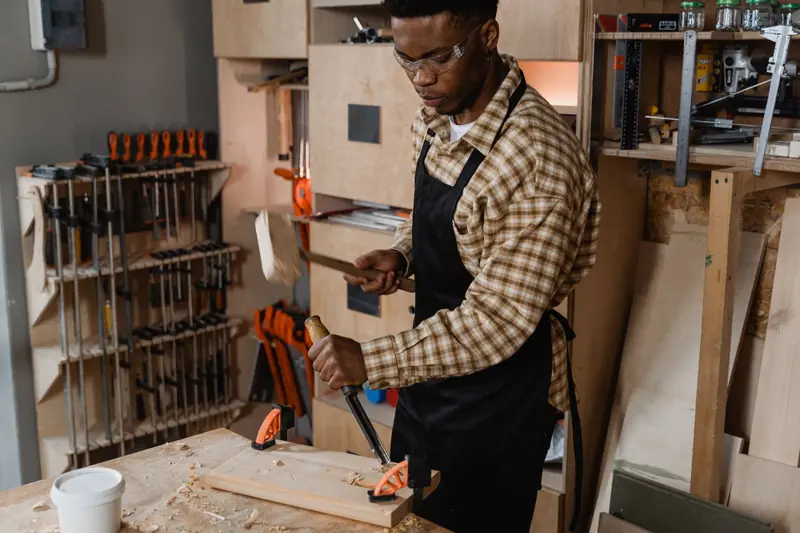
Wood carving with an angle grinder works by fitting a carving disc or attachment to a 4 to 4-1/2 inch grinder, clamping the work firmly and removing wood in light sweeping passes with both hands on the tool and the guard in place. It is the fastest way to rough out bowls, sculptures and large forms, and the riskiest of the common carving tools. This page covers the disc types, grits for sanding, how to hold the grinder, a typical workflow and the safety rules that matter.
What an angle grinder is good for in carving
A grinder removes wood far faster than any hand tool or rotary tool. Carvers use it to hollow bowls and dough troughs, rough out sculpture and figures in large blocks, shape chainsaw carvings, flatten and level surfaces, and refine the outside of spoons and ladles before switching to knives. With finer attachments it also shapes curves and smooths transitions.
It is a poor tool for small pieces and fine detail. A typical 4-1/2 inch grinder runs at around 10,000 to 12,000 RPM with no speed control, so a slip on a small carving removes a lot of wood in a moment. Most carvers rough out with the grinder, then move to a rotary tool, gouges or knives for detail.
Carving discs and attachments, from gentle to aggressive
Flap discs (40, 60, 80 and 120 grit) are the gentlest option and a sensible first attachment. A 40 grit flap disc shapes wood surprisingly quickly and cannot catch the way a toothed disc can; 80 and 120 grit smooth the surface after shaping.
Carbide-tooth shaping discs, with many small carbide teeth or a coarse rasp-like face, remove wood fast with moderate control. They come in flat and dished shapes and suit shaping outsides of bowls and sculpture.
Systems with a few replaceable carbide cutters on a disc, such as the Arbortech TurboPlane and the related ball gouge and barrel carver attachments, cut rather than abrade and remove wood very quickly. Small-diameter ball and barrel attachments reach tighter hollows than a full disc.
Chain discs, which carry a short loop of saw chain around a disc, are the most aggressive and the most prone to kickback. They are not a beginner's disc. Whatever you fit, it must be rated for at least the grinder's maximum RPM and match the spindle, commonly 5/8-11 on US grinders.
How to hold the grinder and control the cut
Always use two hands, one on the body and one on the side handle, and keep the guard on. Stand balanced with the work at about waist height, and position yourself so that if the tool kicks it moves away from your body, not toward it. Clamp the work: a block screwed to a carving vise, a bowl blank held by bench dogs or clamps, or a log fixed in a cradle. Never hold the work in your other hand.
Cut with the part of the disc that is moving away from you and off the edge of the work, and lead with the disc tilted slightly so only part of its face is in contact. Use sweeping passes rather than holding the disc in one place. Toothed discs grab when their leading edge digs in, especially in end grain or at an inside corner; approach those areas with light pressure and a flap disc.
Let the grinder reach full speed before it touches the wood, and lift it off before switching it off. If the disc starts to bounce or chatter, lighten the pressure or change the angle; forcing it is how kickback starts.
A typical workflow: carving a bowl with a grinder
1. Start with a flat-bottomed blank, green or dry, clamped or screwed down so it cannot move. Draw the rim outline and mark the depth you want, leaving a wall of about 1/2 inch to start. 2. Rough the hollow with a carving disc or ball gouge attachment, working from the center outward in overlapping passes and stopping often to check depth.
3. Turn the bowl over, re-clamp it, and shape the outside with a flat or dished shaping disc. Check wall thickness with your fingers or calipers as you go. 4. Switch to a 40 grit flap disc to blend the facets left by the cutters, then 80 and 120 grit to smooth. 5. Finish by hand: a card scraper and 150 to 220 grit paper remove the swirl marks a grinder leaves.
Green wood cuts more easily and throws long ribbons rather than fine dust, but a bowl carved green must dry slowly to avoid cracking. Rough it to a thicker wall, let it dry in a paper bag or a cool spot for several weeks, then finish.
Safety gear and rules for grinder carving
Wear a full face shield over safety glasses, hearing protection and a respirator or mask rated N95 or better; grinder carving produces large volumes of fine dust. Wear close-fitting clothes, tie back hair and do not wear gloves with loose cuffs near the disc. Leather or cut-resistant gloves help against chips and abrasion, but no glove stops a toothed disc.
Check discs before every use for cracked teeth, loose cutters and damage, and never fit a disc larger than the guard allows or a wood-cutting disc without a guard. Unplug the grinder before changing attachments. Keep the cord behind you and out of the cutting path. If you are new to grinders, start with flap discs and spend a few hours learning how the tool behaves before fitting a toothed carving disc.
Frequently asked questions
Can you use any angle grinder for wood carving? Most 4 to 4-1/2 inch grinders accept wood carving discs, provided the disc's bore fits the spindle and its RPM rating is at least the grinder's maximum speed. A variable-speed grinder or one with a paddle switch that stops when released adds control and safety.
What is the safest angle grinder disc for carving wood? A flap disc is the safest common choice, because it abrades rather than cuts and does not grab. Carbide shaping discs are next; chain-style discs are the most aggressive and the most likely to kick back.
Is an angle grinder or a Dremel better for wood carving? They do different jobs. A grinder removes large amounts of wood quickly on bowls and sculpture; a Dremel or other rotary tool handles smaller pieces and detail. Many carvers use the grinder to rough out and the rotary tool to refine.
Do you need to remove the guard to carve with a grinder? No, and you should not. Some carving discs come with their own guard or are designed to work with the standard guard rotated to the right position. Running a toothed disc with no guard removes the main protection against a disc that catches.
What you need for this
- See price on AmazonAmazon
Proxxon 38644 Die-Cast Aluminum Power Carver MOS
From Best Electric Wood Carving Tools: Power Carvers, Power Chisels and Flex Shafts
- See price on AmazonAmazon
Woodriver Carving Vise
From Best Wood Carving Vises: Faceplate Carving Vises, Patternmaker's and Ball Joint
- See price on AmazonAmazon
Schaaf whittling gloves, EN388 Level 5, Medium
From Best Whittling Gloves: Cut-Resistant Gloves by Cut Level and Size
- See price on AmazonAmazon
CAELUM Carbide Rotary Burr Set, 3 Pcs
From Best Dremel Wood Carving Bits: Carbide Burrs, HSS Cutters and Kits