How-to
How to Sharpen a Spoon Carving Hook Knife Step by Step
Published
As an Amazon Associate we earn from qualifying purchases. This does not change our picks. Affiliate disclosure
New to Prime? Try Prime free for fast, free shipping on eligible items.
Short answer
Sharpen the bevel side only. On the Morakniv 164 and knives ground like it, that is the outside of the curve. Color the bevel with a marker, work it with wet-dry sandpaper from 400 up to 1,000 or 1,500 grit until a burr forms, take the burr off the flat inside with fine paper on a dowel, then strop both sides with compound. Keep the maker's angle: Morakniv gives 24 to 26 degrees.
Gear for this job
All 7 picks comparedSharp Pebble grooved stones, 400 and 1000 grit
See price on AmazonSee it on AmazonFlexcut SlipStrop PW12 with Gold compound, 1 oz
See price on AmazonSee it on AmazonBluvizo contoured 400/1000 stones with bamboo base
See price on AmazonSee it on Amazon
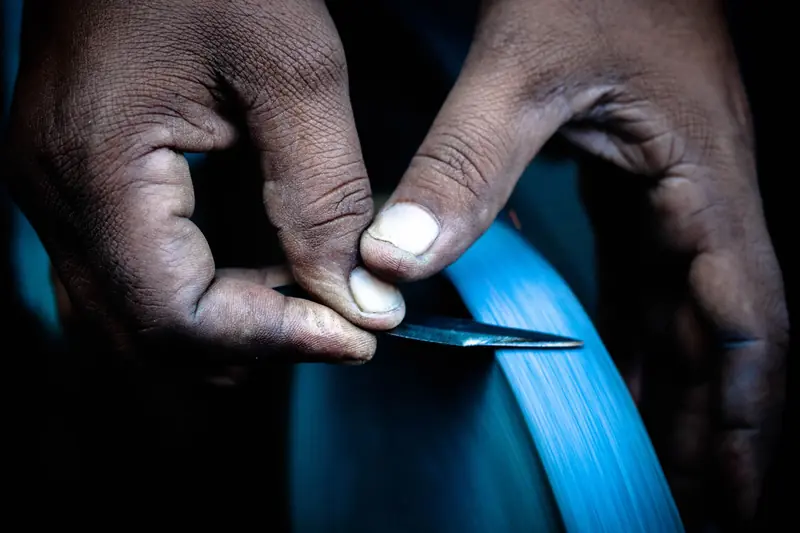
A flat stone cannot follow a hook, which is why a spoon knife so often stays dull. The fix is to bring the abrasive to the blade: sandpaper wrapped around a small block for the outside and around a dowel for the inside. Nothing here needs a machine. This page covers the hook knife only. The straight knife in a spoon carving kit is sharpened flat on a stone, as described in how to sharpen a whittling knife. The grits and pass counts below are the ones published by Popular Woodworking and Home Fixated, named where they are used.
What you need to sharpen a hook knife
Nothing on the list is a special tool. The sizes are the ones the two how-to sources use: Popular Woodworking wraps the paper around a 5/8 inch block and a 5/8 inch dowel, and Home Fixated glues 6 inch strips of paper to 1/2 inch dowels.
- Wet-dry sandpaper in three or four grits between 400 and 1,500, for example 400, 600 and 1,000.
- A round dowel 1/2 to 5/8 inch across, or whichever size sits snugly inside the curve of your knife.
- A small flat block of scrap wood about 5/8 inch wide, to back the paper on the outside bevel.
- A permanent marker, to show where the abrasive is cutting and where it is not.
- A leather strop and polishing compound, plus a strip of leather on a dowel for the inside of the hook.
Which side of a hook knife do you sharpen?
A hook knife has one bevel. On the Morakniv 164 the bevel is on the outside of the curve and the inside is flat, with a published edge angle of 24 to 26 degrees. The bevel is the ground band that meets the edge. Abrasive goes on the bevel. The flat side is only touched to take off the burr. A second bevel ground onto the flat side changes how the knife enters the cut, so keep that side flat.
Not every knife is ground the same way. Home Fixated, for example, works the inside of its knife with sandpaper on a dowel and strops the outside. Look at your own blade before you start: the side with the ground band along the edge is the one that gets the abrasive. Published angles for the other carving tools are in the sharpening angle chart.
How to sharpen a spoon carving knife step by step
The sequence is the one Popular Woodworking describes for an outside-bevel hook knife: marker, block on the bevel, dowel on the inside, strop. Hold the knife still by the handle and move the abrasive, not the knife. Keep the fingers that guide the block behind the edge.
- 1
Color the whole bevel with the marker, from the handle end of the curve to the tip. The ink shows where the paper touches and where it misses.
- 2
Wrap 400 grit paper around the flat block. Lay it flat on the bevel and push from the middle of the blade out toward the cutting edge. Work along the whole curve until all the ink is gone.
- 3
Feel the flat inside for a burr, a thin wire of metal turned over the edge. It should run the full length of the hook. Where there is none, color that part again and repeat step 2 there.
- 4
Repeat steps 1 and 2 with each finer grit, for example 600, then 1,000, up to 1,500. A grit is done when its finer scratches cover the whole bevel.
- 5
Wrap the finest paper around the dowel. Lay it flat against the inside of the hook and glide it along the blade with light pressure, a few passes, only until the burr is gone. Do not tilt it into the edge.
- 6
Rub polishing compound into the strop. Strop the outside bevel with the leather flat on it, moving away from the edge. Strop the inside with leather on the dowel. Home Fixated alternates the two sides several times.
- 7
Wipe off the black residue, then try the knife on a spoon bowl or a scrap of green wood with a shallow bite.
Note.Pass counts are rarely published. Home Fixated gives 10 to 20 passes with 400 grit before repeating with 600 and 1,000. Treat that as a starting point and let the marker and the burr tell you when to stop.
Which grit to start with
Start as fine as the damage allows, so that no more steel comes off than the edge needs. Popular Woodworking runs from 400 to 1,500 grit. Home Fixated uses 400, 600 and 1,000. Flexcut's sharpening notes make the general point for carving tools: routine upkeep is the strop, and stones are too coarse for it.
| What you see | Start with | Then |
|---|---|---|
| Edge drags or leaves a dull surface, no visible damage | Strop with compound, outside and inside | Go to paper only if stropping does not bring the edge back |
| Edge reflects light in spots, or the bevel is rounded | 600 to 1,000 grit on the bevel | 1,500 grit if you have it, burr off the inside, strop |
| Visible nicks along the edge | 400 grit on the bevel | 600, then 1,000 to 1,500, burr off the inside, strop |
How to tell the hook knife is sharp
Three checks, in order. The marker test: after the last grit no ink is left anywhere on the bevel, so the abrasive has reached the edge along the whole curve. The burr test: a fingertip drawn off the flat inside, away from the edge, feels nothing catch. The light test: held under a lamp, the edge shows no bright line or dots, and the stropped bevel shines. Popular Woodworking's mark is a surface polished enough to show a reflection.
Then cut wood. A sharp hook knife takes a clean curl out of a spoon bowl with a shallow bite and leaves a smooth surface. A dull one skips over the wood or tears it.
How often to strop a hook knife
Strop far more often than you sharpen. Flexcut's rule for its carving tools is to strop when the tool starts to drag. Carvers commonly quote every 10 to 30 minutes of carving, which is a habit and not a maker figure. A few strokes with compound on the outside bevel and with the dowel strop inside keep the edge going, and the sandpaper stays in the drawer until the edge is nicked or rounded. Strop technique for straight blades is in how to strop a carving knife.
Note.Keep the leather flat on the bevel. Lifting it over the edge rounds the edge, and a rounded hook knife has to go back to sandpaper.
Still skipping or tearing after sharpening?
If the edge passes the checks and the knife still misbehaves, the cause is in the cut. The standard causes are a bite that is too deep and a knife made for the other hand: the Morakniv 164 is a single-edge knife sold in right-hand and left-hand versions. Cutting against the grain in the bowl tears the wood even with a sharp edge. Grips and grain direction are covered in how to use a hook knife.
Bent gouges used for spoon bowls are a different job, because the edge is rolled across the abrasive as it moves: see how to sharpen carving gouges.
Quick answers
Short answers on spoon carving sharpening. Grit and pass figures come from Popular Woodworking and Home Fixated, the angle from Morakniv.
- How to sharpen a spoon carving knife without special stones? Wrap wet-dry sandpaper, 400 to 1,500 grit, around a small block for the bevel and around a dowel for the inside, then strop.
- What angle is a hook knife sharpened at? Keep the maker's bevel. Morakniv publishes an edge angle of 24 to 26 degrees for the 164.
- Do you sharpen the inside of a hook knife? On an outside-bevel knife, no. The inside stays flat and only the burr is removed there.
- How to sharpen the other spoon carving tools? The straight knife goes flat on a stone, then a strop. Gouges are rolled on the stone and stropped inside with a shaped strop.
What you need for this
- See price on AmazonAmazon
Sharp Pebble grooved stones, 400 and 1000 grit
From Best Sharpening Kits for Wood Carving Knives, Hook Knives and Gouges
- See price on AmazonAmazon
Bacher leather strop 12.6 in, 4 compounds and balm
- See price on AmazonAmazon
BeaverCraft SK1 hook knife, right-handed
From Best Spoon Carving Hook Knives: Right-Hand, Left-Hand and Double-Edge
- See price on AmazonAmazon
BeaverCraft DIY04 spoon carving kit with blank
From Best Spoon Carving Kits: What Is in the Box and What Is Missing