Fix
Why Is Whittling So Hard? Six Causes and How to Fix Each
Published
As an Amazon Associate we earn from qualifying purchases. This does not change our picks. Affiliate disclosure
New to Prime? Try Prime free for fast, free shipping on eligible items.
Short answer
Whittling is hard mostly for three reasons: a dull edge, the wrong wood and cutting against the grain. A new knife often needs stropping before its first cut, basswood at 410 lbf cuts far more easily than oak at over 1,200 lbf, and cuts have to run downhill with the grain. Fix those three and a thin cut takes little force.
Gear for this job
All 7 picks comparedFlexcut KN13 detail knife, 1.5 in blade
See price on AmazonSee it on AmazonBeaverCraft C4s sloyd knife, 3 in, with sheath
See price on AmazonSee it on AmazonMorakniv 106 wood carving knife, 3.25 in blade
See price on AmazonSee it on Amazon
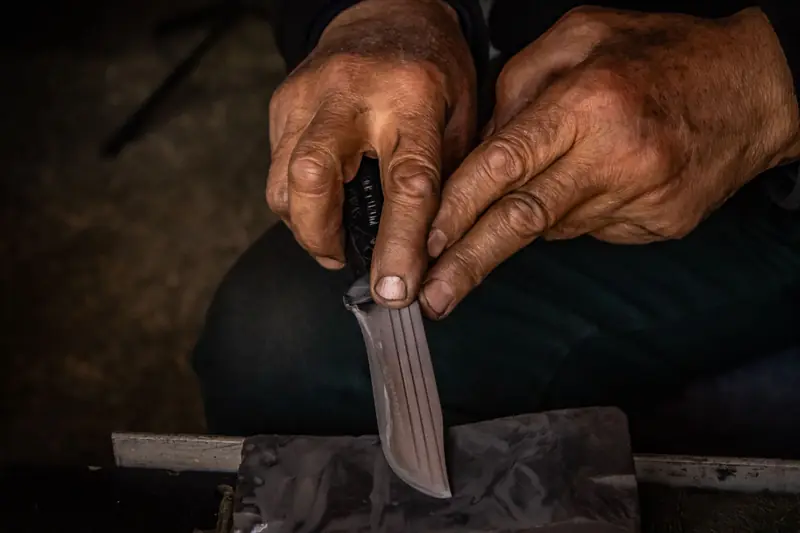
This is for the person who tried it, pushed hard, got nowhere and ended up with a sore hand. It does not mean you lack strength or skill. A sharp whittling knife in the right wood cuts with light pressure. When it takes heavy pressure, something specific is wrong, and each cause leaves its own sign in the wood. The table lists the causes from most to least likely. Check them in that order, because a dull edge makes every other problem look worse. It also matters for safety: a sharp tool needs less force and is easier to control.
What you see, the likely cause and what to do
Find the row that matches what the knife and the wood are doing. The causes are ordered most likely first, and more than one can apply at once. Start at the top: there is no point judging the wood or the grain with a dull knife.
| What you see | Likely cause | What to do |
|---|---|---|
| Knife needs a hard push even on thin cuts. The cut surface is dull or torn, not shiny | Dull edge, often the factory edge | Strop until a thin cut leaves a shiny surface. Chips or glints on the edge: stone first |
| Edge is sharp but every cut takes force. Hard bands in the wood turn the blade aside | Wrong wood: pine lumber, oak or another hard species | Switch to basswood (410 lbf) or butternut (490 lbf) |
| Wood splits ahead of the edge. The knife dives in and the surface tears | Cutting against the grain | Turn the piece and cut from the other direction, downhill with the grain |
| Blade wedges and stops. You lever the handle to break the chip off | Cuts too deep | Take thin shavings. Make a stop cut first where a cut has to end |
| Knife is sharp but wedges in the wood, even in basswood | Blade too thick or edge angle too steep | Use a thin whittling knife: published edge angles are 12 to 20 degrees inclusive |
| A basswood block feels much harder than it should with a stropped knife | Very dry wood | Mist the surface with about half rubbing alcohol, half water, or change the block |
Cause 1: a dull edge, often straight from the box
Rule this out first. New does not mean sharp: a dull factory edge is a standard cause of a first failed attempt. Carving is Fun states the problem plainly: a dull knife needs more force to cut, and that puts you at higher risk of being cut as the knife exits the wood. Flexcut's sign is drag. When the tool feels as if it is dragging through the cut, it needs the strop.
The fix is the strop, not more force. Lay the bevel flat on leather loaded with compound and pull the knife away from its edge. Carvers commonly strop every 10 to 30 minutes of carving. Steps and stroke counts are in how to strop a carving knife. If stropping changes nothing, or you can see chips on the edge, the knife needs a stone: see how to sharpen a whittling knife.
Cause 2: the wrong wood
Wood from the hardware store or the yard is the usual culprit. On the Janka scale basswood is 410 lbf. Southern yellow pine is 690 lbf, with hard resinous bands that turn the edge aside. Northern red oak is 1,220 to 1,290 lbf and open-pored: it is carved with gouges and a mallet, not with a knife. The rule used on this site: dry wood up to about 600 lbf whittles well, and ring-porous hardwoods above about 1,050 lbf do not.
Start with basswood, then butternut at 490 lbf. Eastern white pine at 380 lbf also whittles if the board is clear of knots. Look up any other species in the wood for carving chart, and see can you whittle pine for store lumber.
Cause 3: cutting against the grain
Wood fibers run along the block. Cut downhill, with the grain, and the edge slices the fibers cleanly. Cut the other way and the edge gets under the fibers and lifts them. Carving is Fun describes the sign: the wood starts to split and separate on its own, ahead of the knife edge, instead of being cut.
The fix takes a second. Stop, turn the piece around and cut from the other direction. On a curved shape the right direction changes along the cut, so expect to turn the piece often. If a cut starts to dig in, do not push through it. Back out and come from the other side.
Cause 4: cuts that are too deep
A knife is a wedge. The deeper it goes, the more wood it has to push aside. If the blade stops and you are levering the handle to snap the chip off, the cut is too deep. Take thin shavings and make more of them. Bubble Relief's beginner advice says the same: thin slices, never a lot of wood at once. Where a cut has to end at a line, make a stop cut first. That is a straight cut that the second cut runs into, so the chip comes free without prying.
Cause 5: a blade that is too thick
Blade shape matters as well as sharpness. Thin whittling and detail knives are sharpened to about 12 to 20 degrees inclusive, with one flat bevel per side and no secondary bevel. Carving is Fun warns against edge angles of 45 degrees or larger. A thick blade with a steep edge acts as a wedge even when it is sharp.
A sloyd knife such as the Morakniv 106 or 120 is 2.7 mm thick with a 26 to 28 degree edge angle, the usual choice for green wood and spoon work. For small figures in dry basswood, carvers usually pick a short, thin detail blade, such as the Flexcut knives with 1-1/4 to 1-3/4 inch blades. For folding knives see whittling with a pocket knife.
Cause 6: wood that is very dry
Green wood cuts far more easily than dry wood, which is why spoon carvers work fresh-cut wood. Carving blocks are sold dry, and an old, very dry block can feel harder than expected. Common carver practice is to mist the surface with about half rubbing alcohol, half water and carve it damp. This is a habit among carvers, not a maker instruction. Soaking a whole block is not standard: it invites cracks as the wood dries.
How to keep whittling from getting hard again
Five habits prevent most of the trouble above. None of them needs new gear beyond a strop, a glove and the right block of wood.
- Strop before the first cut and whenever the knife starts to drag. Do not wait until it stops cutting.
- Buy carving wood, not lumber: basswood blocks first, then butternut.
- Read the grain before each cut and turn the piece instead of forcing the knife.
- Take thin cuts, and keep the path of the blade clear of the holding hand, legs and other people.
- Wear a cut-resistant glove on the holding hand and a thumb guard on the knife-hand thumb. Gloves reduce slicing cuts. They are not cut-proof.
Quick answers
Short answers on how hard whittling is and how long it takes to learn. The learning time is one hobby guide's estimate, not a measured figure.
- Is whittling hard? Not with a sharp knife and basswood. It feels hard when the edge is dull, the wood is too hard or the cut runs against the grain.
- Is whittling easy? The basic cuts are simple: push cut, pull cut and stop cut. Clean shapes and fine detail take repeated practice.
- Is wood carving hard to learn? The Whittling Guide's estimate: many beginners learn the basic cuts in a weekend, and shaping and detail improve over repeated short sessions.
- How long does it take to learn wood carving? There is no fixed figure. One hobby guide says a weekend for the basic cuts. Carving is Fun times its small first projects at 20 to 40 minutes each.
What you need for this
- See price on AmazonAmazon
Flexcut KN13 detail knife, 1.5 in blade
From Best Whittling Knife for Beginners: Fixed-Blade Carvers Compared
- See price on AmazonAmazon
BeaverCraft BW19 Basswood Carving Blocks
From Best Basswood Carving Blocks: Sizes, Pack Counts and Price per Block
- See price on AmazonAmazon
Bacher leather strop 12.6 in, 4 compounds and balm
- See price on AmazonAmazon
Schaaf whittling gloves, EN388 Level 5, Medium
From Best Whittling Gloves: Cut-Resistant Gloves by Cut Level and Size