Explainer
Whittling With a Pocket Knife: Which Knives Work and Which Do Not
Published
As an Amazon Associate we earn from qualifying purchases. This does not change our picks. Affiliate disclosure
New to Prime? Try Prime free for fast, free shipping on eligible items.
Short answer
Yes, you can whittle with a pocket knife if the blade is thin, short enough to control and stropped to carving sharp. An Opinel No.6, No.7 or No.8 locks open and suits the job. A Swiss Army knife or a slipjoint works for light cuts but has no lock. A thick tactical folder cuts poorly. Start in basswood, 410 lbf on the Janka scale.
Gear for this job
All 6 picks comparedOpinel No.08 Carbone folding knife, 3.35 in blade
See price on AmazonSee it on AmazonFlexcut Whittlin' Jack JKN88, 2 carving blades
See price on AmazonSee it on AmazonFlexcut Detail Jack JKN90, single detail blade
See price on AmazonSee it on Amazon
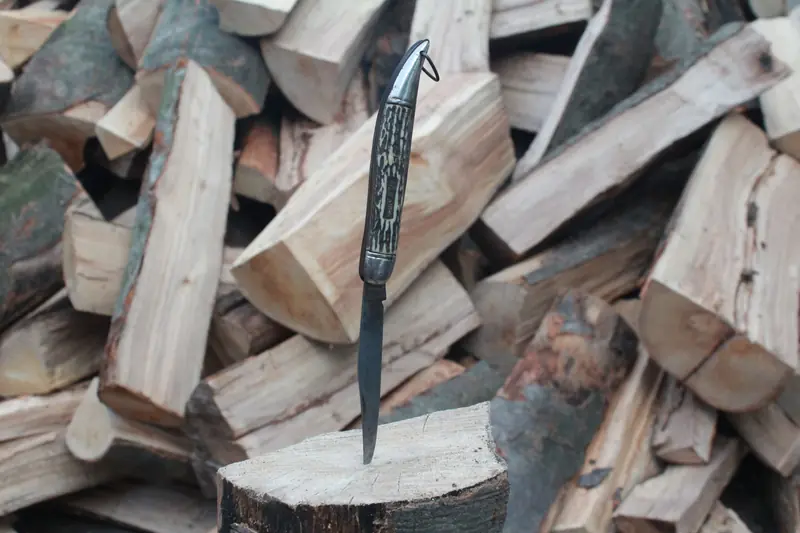
The knife in your pocket was sharpened for boxes and cord, not for wood. Three things decide whether it whittles: how thick the blade is behind the edge, whether that edge has been honed and stropped, and whether the blade locks open. A folding knife used for whittling should lock, so a knife without a lock is kept to light, controlled cuts. This page goes through the common pocket knife types one by one, says what to change on the edge, and gives three cuts to try on a first block.
Can you whittle with a pocket knife? Verdict by knife type
The table sorts the common folding knives by what matters in wood: the lock, the blade and the edge. The verdicts follow from those features as makers and standard references state them. They are not test results, and locks and blades vary inside a brand, so check your own model.
| Knife | Lock | Blade | Whittling | Change on the edge |
|---|---|---|---|---|
| Swiss Army knife, standard models | None: a slipjoint | Stainless, about 56 HRC. Large blade roughs, small blade details | Yes, light cuts | Hone and strop to carving sharp |
| Swiss Army knife, some 111 mm models | Liner lock on the main blade | One longer main blade | Yes | Hone and strop to carving sharp |
| Opinel No.6, No.7, No.8 | Virobloc ring locks the blade open | One thin blade, 2.87 to about 3.3 in, carbon or stainless | Yes | Strop before the first cut |
| Opinel No.2 to No.5 | None | One blade, 1.36 to 2.36 in | Light cuts only | Strop before the first cut |
| Slipjoint: stockman, Barlow, trapper | None: held by a backspring | Two or three short blades | Yes, light cuts | Lower the bevel to about 20 degrees, then strop |
| Carving jack, e.g. Flexcut Whittlin' Jack | None, as its listing states | 1.5 in detail blade and 2 in roughing blade | Yes: made for it | Arrives sharpened. Strop only |
| Tactical folder | Usually locks | Thick blade, steep edge, some partly serrated | Poor | Not worth regrinding. Use another knife |
Do you need a special knife for whittling?
No. A whittling knife is only better shaped for the work. Flexcut detail knives carry blades of 1-1/4 to 1-3/4 inches. The Morakniv sloyd knives run 62 mm (2.4 in) on the 120 and 85 mm (3.3 in) on the 106, both 2.7 mm thick. Each has one flat bevel per side with no secondary bevel, and a fixed handle that fills the hand.
A pocket knife gives up two of those things. The blade folds, and the edge is usually ground for general use. Length is not the problem: the 8.5 cm blade of an Opinel No.8 is as long as the Morakniv 106. If the wood still fights back after stropping, the cause is rarely the knife alone. The six usual causes are on the page why is whittling so hard.
Why the lock matters on a folding knife
A slipjoint holds its blade open with a backspring. Spring tension is all that keeps it there: nothing locks. Most Swiss Army knives and the traditional patterns such as the stockman and the Barlow are built this way. If a cut puts pressure on the back of the blade, or the tip catches and the knife twists, the blade can fold toward the fingers that hold the handle.
That is why standard blade safety says a folding knife used for whittling should lock. Opinel fits its Virobloc ring to the No.6 and larger. Turn the ring after opening the blade. The No.2 to No.5 have no ring. With a knife that does not lock, take thin shavings, keep the force on the cutting edge only and never pry a chip out with the tip.
Note.A lock is not a guarantee. Keep the path of the blade clear of the holding hand, your legs and other people whether the blade locks or not.
Which Opinel for whittling?
Any of the three locking sizes people carry. Opinel USA lists the blades at 2.87 inches for the No.6 and 3.07 inches for the No.7. The No.8 has an 8.5 cm blade, about 3.3 inches. Overall lengths open are 6.5, 7 and about 7.6 inches. The No.8 matches a full-size sloyd knife for long roughing cuts. The No.6 puts the tip closer to the hand, which helps on small figures.
Both steels work. The Carbone blade is XC90 carbon steel, which Opinel describes as easy to regrind and highly susceptible to corrosion: dry it after each use and oil it regularly. That matters with green wood, which is wet. The Inox blade is modified Sandvik 12C27 stainless and needs no such care.
What to change on the edge before you start
Carving sharp is not the same as box-opening sharp. Thin whittling knives are published at 12 to 20 degrees inclusive, and BeaverCraft states a 20 degree bevel for its knives. One hobby reference suggests bringing the bevel of a traditional pocket knife down to about 20 degrees for cleaner slices in wood. A lower angle cuts with less force and dulls or chips sooner. All published figures are in the sharpening angle chart.
Swiss Army blades average about 56 HRC, softer than the 58 to 62 HRC the same reference prefers for whittling, so expect to touch up the edge often. Routine upkeep is the strop with polishing compound, pulling the blade away from its edge. Strop when the knife starts to drag. The stone method is in how to sharpen a whittling knife, the strop routine in how to strop a carving knife.
How to whittle with a pocket knife: three cuts to try first
Use a dry basswood block. At 410 lbf it is the standard first wood, and the wood for carving chart shows what else a knife can handle. Sit down with both feet on the ground and nobody within arm's length, as Victorinox's safety rules for its knives put it. Wear a glove on the holding hand.
- Push cut. The blade moves away from you and lifts a thin shaving. The holding hand stays behind the edge. This is the cut Victorinox's rule describes: the knife always moves away from the body.
- Stop cut. Press the edge straight into the wood to make one straight cut. A second cut then runs into it and the chip ends cleanly at that line instead of splitting on.
- Pull or paring cut. Short strokes toward the knife-hand thumb, with a thumb guard or tape on that thumb. It is a standard carving knife cut. Under Victorinox's away-from-the-body rule, leave it out with a Swiss Army knife.
Note.Cut downhill, with the grain. If the blade dives in and the wood splits ahead of it, turn the block around and cut from the other direction.
Can you carve a spoon with a Swiss Army knife?
The outside, yes. A straight blade shapes the handle and the back of the bowl, and Victorinox lists wooden spoons among its carving projects. Fine Woodworking's spoon guide notes that a well-sharpened pocketknife can stand in for the sloyd knife on a beginner project. The hollow of the bowl is the limit: a straight blade cannot scoop it. That takes a hook knife or a gouge, and green wood makes the whole job far easier.
Quick answers
Short answers to the questions people ask before they open the blade. Each one follows from the table and the sections above.
- Can you whittle with a Swiss Army knife? Yes, in soft wood with light cuts. Most models have no lock, so keep the force on the edge and strop the blade first.
- Can you whittle with any knife? Any thin, sharp blade cuts basswood. Thick blades, serrated edges and dull factory edges are what fail.
- Do you need a special knife for whittling? No. A whittling knife adds a short blade, a flat bevel and a fixed handle, which makes the same cuts easier and steadier.
- Which Opinel for whittling? The No.6, No.7 or No.8. All three have the locking ring. The No.8 has the longest blade at 8.5 cm.
- Can you wood carve with a pocket knife? Whittling, yes. Chip carving and relief carving use their own knives and gouges.
What you need for this
- See price on AmazonAmazon
Opinel No.08 Carbone folding knife, 3.35 in blade
- See price on AmazonAmazon
Flexcut KN13 detail knife, 1.5 in blade
From Best Whittling Knife for Beginners: Fixed-Blade Carvers Compared
- See price on AmazonAmazon
Bacher leather strop 12.6 in, 4 compounds and balm
- See price on AmazonAmazon
Schaaf whittling gloves, EN388 Level 5, Medium
From Best Whittling Gloves: Cut-Resistant Gloves by Cut Level and Size