Chart
Wood Carving Gouge Sizes Chart: Sweep Numbers, Widths and What Each Cuts
Published
As an Amazon Associate we earn from qualifying purchases. This does not change our picks. Affiliate disclosure
New to Prime? Try Prime free for fast, free shipping on eligible items.
Short answer
A gouge size has two parts: the sweep number says how curved the edge is, and the width is measured corner to corner. In the Sheffield list #1 is a chisel, #2 a skew, #3 the flattest gouge, #9 a half circle, #10 and #11 U-gouges. Swiss-made Pfeil tools number differently: 5/12 is a series 5 gouge 12 mm wide, the skew is 1S and the flattest gouge is 2.
Gear for this job
All 6 picks comparedFlexcut FR405 deluxe palm gouge set, 9 tools
See price on AmazonSee it on AmazonFlexcut FR310 beginners palm set, 5 tools
See price on AmazonSee it on AmazonUJ Ramelson palm set for fine detail, 5 tools
See price on AmazonSee it on Amazon
Two numbering systems are in use and they do not line up. English makers and many others follow the Sheffield list. Swiss-made Pfeil tools carry their own series numbers and metric widths. A number read off a handle or a listing means little until you know which system the maker uses. The chart below puts both side by side for straight tools and names the system in every column, so it can be printed and kept at the bench. It is built from two carving references and a Pfeil dealer's list, not from measured tools.
Gouge sweep chart: Sheffield list and Swiss numbers
Read across: the Sheffield number, the shape of the cutting edge seen end on, the Swiss-made (Pfeil) series that does the same job, and the usual work. At any given width, the smaller the number, the flatter the tool. Neither list fixes a radius, and the exact curve of a number varies from maker to maker. Chisels and gouges run from 1 to 11 in both lists. V-tools sit at 39 and above in the Sheffield list and at 12 to 16 in the Swiss one.
| Sheffield list | Edge shape | Swiss (Pfeil) | What it cuts |
|---|---|---|---|
| #1 | Straight chisel: flat edge, square across | 1 | Straight lines, flat surfaces, cleaning up to a line |
| #2 | Skew chisel: flat edge ground at a slant | 1S | Corners and tight angles, lettering |
| #3 | The flattest gouge: a barely curved edge | 2 | Leveling and smoothing a background or a broad surface |
| #4 to #8 | Five sweeps, each a step deeper than the last | 3 to 8, each a step deeper | Shallow ones round and smooth a shape. Deeper ones hollow and clear waste faster |
| #9 | Half circle | 9 | Deep hollows, roughing out, round-bottomed grooves |
| #10 and #11 | U-gouges: deeper than a half circle, #11 the taller | 11, the deep gouge. No straight series 10 | Large ones (fluters) cut channels. Small ones (veiners) cut hair, fur and leaf lines |
| #39 | V-tool, 60 degrees between the wings | 12 | Outlining a design, lettering, line work. The most useful V-tool angle |
| #41 | V-tool, 45 degrees | 15 | Narrower, steeper-sided lines |
| #45 | V-tool, 90 degrees | 13 | Wide, open grooves |
| No number in the sources used | V-tools, 55 and 35 degrees | 14 (55 degrees), 16 (35 degrees) | A slightly narrower V than 60, and a very narrow V |
Note.Sheffield numbers 12 to 20 are the bent versions of gouges 3 to 11, 21 to 32 the spoon bent tools and 33 to 38 the back bent ones. Pfeil marks those shapes with a letter instead: L for long bent, a for spoon bent, F for fishtail.
How to read a gouge code such as 5/12 or #7
A Swiss-made tool is marked series, slash, width in millimeters. 5/12 is a series 5 gouge 12 mm wide. 1S/12 is a 12 mm skew chisel and 12/8 is a 60 degree V-tool 8 mm wide. A letter after the series number means the shaft is shaped: 7L is a long bent series 7, 8a is a spoon bent series 8, 3F is a fishtail series 3.
A Sheffield-list tool is usually written as a sweep and a width in inches or millimeters, for example #7 x 1/2 inch. Width is measured from corner to corner of the cutting edge, straight across, not around the curve.
A Sheffield #3 and a Pfeil 2 are both the flattest gouge of their list, and a Pfeil 3 is one step deeper. At 9 the two lists meet again: 9 is the half circle in both.
Common gouge widths in mm and inches
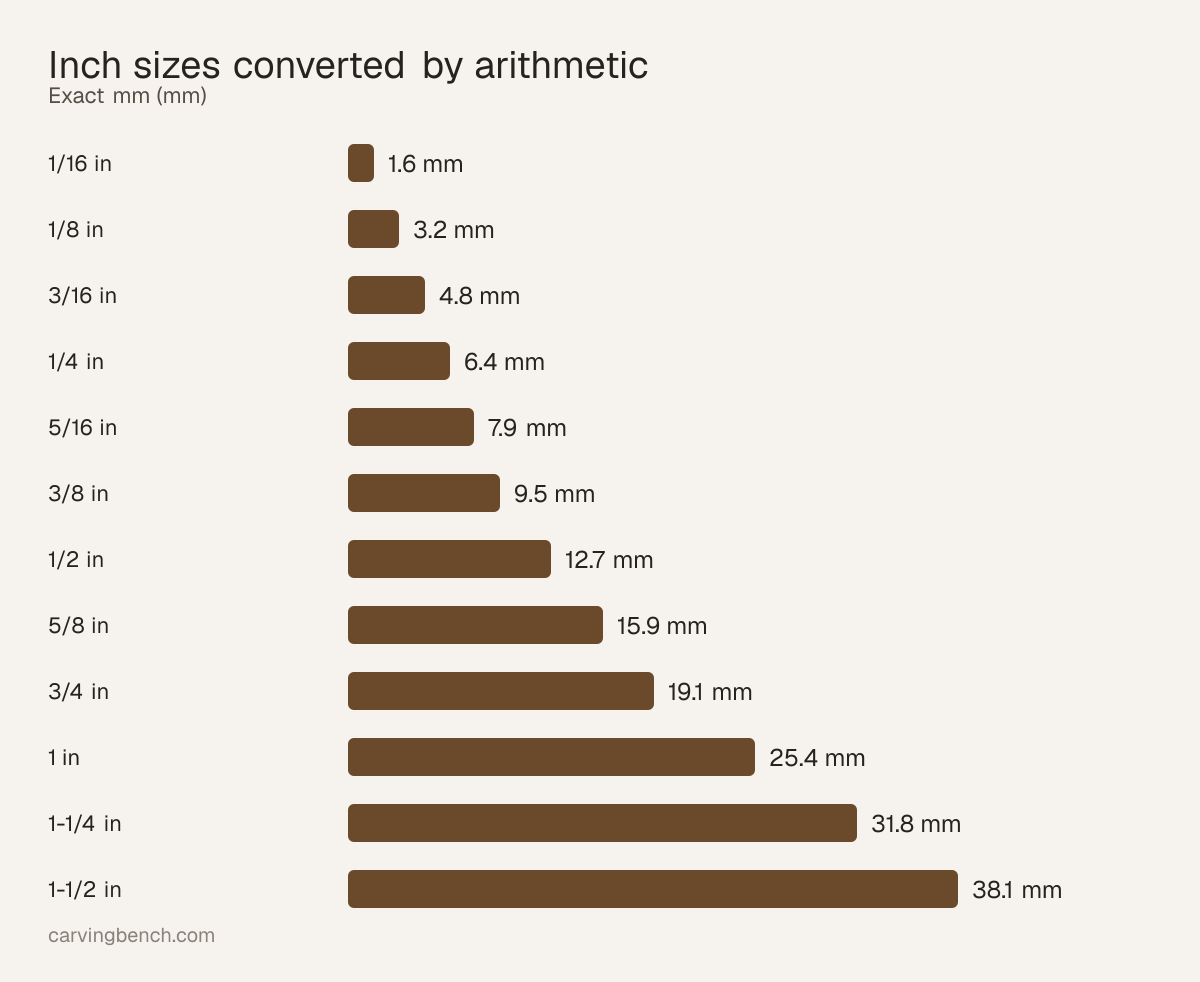
Sheffield-pattern tools are often sold in inch fractions and Swiss tools in millimeters. The table converts the usual inch sizes and gives the nearest width found in the Pfeil straight gouge list, which runs from 0.5 mm in the deep series 11 up to 40 mm. A sweep number is only comparable at the same width: a wide #7 and a narrow #7 are both medium curves, but the wide one cuts a much broader hollow.
| Inch width | Exact mm | Nearest metric width |
|---|---|---|
| 1/16 in | 1.6 mm | 1.5 or 2 mm |
| 1/8 in | 3.2 mm | 3 mm |
| 3/16 in | 4.8 mm | 5 mm |
| 1/4 in | 6.4 mm | 6 mm |
| 5/16 in | 7.9 mm | 8 mm |
| 3/8 in | 9.5 mm | 10 mm |
| 1/2 in | 12.7 mm | 12 or 13 mm |
| 5/8 in | 15.9 mm | 16 mm |
| 3/4 in | 19.1 mm | 20 mm |
| 1 in | 25.4 mm | 25 mm |
| 1-1/4 in | 31.8 mm | 30 mm |
| 1-1/2 in | 38.1 mm | 40 mm |
U-shaped and V-shaped gouges: veiners, fluters and V-tools
U-gouges are #10 and #11 in the Sheffield list. Their sides rise past the half circle, so they cut a deep, narrow channel. Woodcarving Illustrated calls the large ones fluters, used for channels, and the small ones veiners, used for detail lines in hair, fur and leaves. In the Swiss list the deep gouge is series 11, which a Pfeil dealer describes as the narrowest series, suited to fine details like hair.
A wood carving V-tool is two flat chisel wings that meet at a keel. It is named by the angle between the wings: 45 to 90 degrees, with 60 the most useful. The Swiss range adds a 55 degree and a 35 degree tool. The angle between the wings is not the sharpening angle. Bevel figures for each tool are in the sharpening angle chart and the method is in how to sharpen carving gouges.
What size gouge for spoon carving?
A spoon bowl is hollowed with a hook knife or with a bent gouge, whose curved shaft lets the edge reach down into the hollow. Published picks sit in a narrow band. Schaaf Tools describes carvers using a medium sweep, a #5 or #7 about 20 mm wide. David Fisher, writing in Fine Woodworking, lists a #8 bent gouge 30 mm wide for the inside of a spoon's bowl. So: a bent gouge, sweep 5 to 8, roughly 20 to 30 mm (about 3/4 to 1-1/4 inch).
A deeper sweep removes wood faster and leaves more ridges. A flatter sweep leaves a smoother bowl. Choose a width narrower than the bowl you plan to carve. The usual first tool for a spoon bowl is the hook knife: see how to use a hook knife, and the full sequence in how to carve a spoon.
Note.The two authors quote sweeps as their own tools are marked. Check which numbering the maker of your gouge uses before matching a number from this section.
Which gouges to buy first
The starter list from carver Chris Pye, in Sheffield numbers, is short: #3, #6 and #9 gouges, each in 1/4 and 1/2 inch, plus a 3/8 inch skew chisel and a 3/8 inch 60 degree V-tool. That is one flat, one medium and one half-circle sweep in two widths, which covers leveling, shaping and hollowing.
Before buying a set, read the sweep and the width of every tool in the listing and check which numbering the maker uses. Palm tools are short gouges pushed with one hand, and their sizes are read the same way. The gouge set guide lists what each set contains.
Note.Gouges are ground for the wood: Pfeil gives a bevel of 17 degrees for softwood up to 25 degrees for hardwood. Keep the bevel the maker ground and maintain it on a strop.
Quick answers
Short answers to the gouge questions people search for. Numbers are Sheffield list numbers unless the Swiss (Pfeil) system is named.
- What do wood carving gouge sizes mean? The first figure is the sweep, how curved the edge is, from #1 (flat chisel) to #11 (deep U). The second is the width, measured corner to corner.
- What size gouge for spoon carving? A bent gouge, sweep 5 to 8, about 20 to 30 mm wide, going by Schaaf Tools and Fine Woodworking. A hook knife does the same job.
- What is a wood carving V-tool used for? Outlining, lettering and line work. V-tools run from 45 to 90 degrees between the wings, and 60 is the most useful.
- Are U-shaped and V-shaped gouges the same? No. A U-gouge (#10, #11) has a round bottom and cuts a channel. A V-tool has two flat wings and cuts a sharp-bottomed line.
- Is a #3 gouge the same in every brand? No. In the Sheffield list #3 is the flattest gouge. In the Swiss (Pfeil) list the flattest is 2 and a 3 is one step deeper.
Use this chart
Print it, save the image version, or put it on your own site or forum post with the code below. The code keeps a link back to this page as the source.
Embed code
<a href="https://carvingbench.com/blog/wood-carving-gouge-sizes"><img src="https://carvingbench.com/charts/wood-carving-gouge-sizes/image.png" alt="Wood Carving Gouge Sizes Chart: Sweep Numbers, Widths and What Each Cuts" width="600" loading="lazy"></a>
<p>Source: <a href="https://carvingbench.com/blog/wood-carving-gouge-sizes">Wood Carving Gouge Sizes Chart: Sweep Numbers, Widths and What Each Cuts</a>, Carving Bench</p>
What you need for this
- See price on AmazonAmazon
Flexcut FR405 deluxe palm gouge set, 9 tools
From Best Wood Carving Gouge Sets: Palm Tools for Hand Carving
- See price on AmazonAmazon
BeaverCraft SK1 hook knife, right-handed
From Best Spoon Carving Hook Knives: Right-Hand, Left-Hand and Double-Edge
- See price on AmazonAmazon
Sharp Pebble grooved stones, 400 and 1000 grit
From Best Sharpening Kits for Wood Carving Knives, Hook Knives and Gouges
- See price on AmazonAmazon
Bacher leather strop 12.6 in, 4 compounds and balm